Ed Keller

“It’s Nothing New, But It’s All Tragic”

 featured  Comments Off on “It’s Nothing New, But It’s All Tragic”
Jul 152013
 

Trayvon Martin protest poster

Click above the image to listen to an interview with a protester, interspersed with sounds from the July 14, 2014 protest of the George Zimmerman verdict in Union Square, New York City.

Zimmerman Verdict protest, July 14, 2014

We went to the Zimmerman verdict protest yesterday in Union Square. This is an interview/audio piece made from recordings of the event. Sometimes there’s not much sense to make but, in any case, here are people speaking and being together, trying to decide what’s next. The interludes are repetitive.

The same phrases echo through the event, through many events, come to think of it through American history at a far broader scale. Why do such things return? “It’s nothing new, but it’s all tragic.”

May 152013


The tuxedos and formal gowns worn by orchestra performers haven’t changed much for more than a century. At The New School, some students are hoping to change that.

As part of a year-long collaboration with the Baltimore Symphony Orchestra, initiated by its music director, Marin Alsop, teams of students from the Integrated Design and Design and Technology programs atParsons The New School for Design worked collaboratively with their peers from Mannes College The New School for Music to envision the future of orchestral performance. The students created innovative performance wear that incorporated sustainable fashion concepts and wearable technology features.. The project was led by faculty members Sabine Seymour, director of the Fashionable Technology Lab at Parsons and fashion designer Gabriel Asfour of ThreeASFOUR, with support from Mannes Dean Richard Kessler.

The fruits of their work were presented Sunday, May 5, as the kickoff of the third annual Parsons Festival, which runs through May 24. Above, watch a performance created by the Visuano team. Their presentation uses a motion-activated digital projection system developed by Quiyi Wu and Boshan Zhou, students in the  MFA Design and Technology program at Parsons, and visiting scholar Yinan Zhang. Their system is based on a Kinect box and other technologies, including custom software. The projections create beautiful colorfields that dance in time to the pianist’s performance.

 Posted by at 2:06 pm featured Tagged with:  Comments Off on A Symphony of Looks – The Future of Orchestral Garments
May 142013
 

SoundMixer2013_Poster

Calling all faculty, students, musicians, designers, scholars and artists working with sound. Join us for a mixer wednesday evening May 15th 7:00 – 8PM. Mingle with fellow sound geeks and chat about how sound can be used as a tool for transdisciplinary activity and collaboration.


Open Lab 12th Floor Studio in 6 E 16th St.

 Posted by at 1:50 pm featured Tagged with:  Comments Off on Sound Mixer! – This Wednesday, May 15
Apr 252013
 
Please join us for a special evening of musical and visual stimulation on Sunday, May 5 from 6:00-8:00 p.m. in the Theresa Lang Community and Student Center at Arnold Hall, 55 W 13th Street, 2nd Floor.

Interdisciplinary design teams from Parsons have partnered with musicians from Mannes to present a live showcase of interactive performances featuring avant-grade orchestral garments and motion and sound-activated technology.  This event is the culmination of a year-long collaboration with the Baltimore Symphony Orchestra to imagine the future of orchestral performance in a networked world where the audience gains access to new ways of experiencing and interacting with music – both inside and outside the concert hall.

Program:
WILLIAM BOLCOM: A Serpent’s Kiss for piano
STUART SAUNDERS SMITH:  When Music is Missing, Music Sings for percussion
LOWELL LIEBERMANN: Piano Quintet

ADMISSION: Free, advance registration required.
 Posted by at 9:52 am featured Tagged with:  Comments Off on The Future of Orchestral Garments Presented by Parsons with Mannes and The Baltimore Symphony Orchestra
Apr 222013
 

Instructor: Benjamin Tausig

CRN 1910
June 3 – June 27,
Monday-Thursday, 4:00 – 5:50
Course Description  
A Puerto Rican-born New Yorker rides his bicycle from the South Bronx over the Willis Avenue Bridge into Manhattan, a Don Omar single issuing from the boombox attached to the rear of his Schwinn. The music is amplified by his stereo system, and contorted by the Doppler effect, adjacent automobile traffic, and the flowing water of the Harlem River below.
All sound is marked by motion, but rarely more so than in a city like New York, where every block seems to represent a sonic world transplanted, where the subway is a hornet’s nest of expectations about sound and personal space, and where any sound produced will, almost by default, traverse private boundaries.
This month-long, intensive summer course meets four days a week, and examines the myriad dimensions of sound and mobility in New York, from the routes by which sonic cultures immigrate to cities to the ways that sound moves through built physical spaces, from the normative social rules of sound in spaces of transportation to broadcasting technologies that set sound in motion in new ways. We will read a rich cross-section of work including ethnographies of immigrant music, theoretical writing on sound and mobility, and practical texts on sonic field recording. In addition, students will be expected to make weekly sound recordings in the city, both on their own and in group field trips, using equipment from the New School media lab. We will explore strategies for examining and representing sound in motion in urban space. Final projects will include the option of written pieces or media presentations.
 Posted by at 10:07 am Courses Comments Off on Course Summer 2013 – Urban Soundscapes
Apr 222013
 

Jonathan Sterne

What does it mean to represent acoustic space acoustically?  What can we learn about social space by starting with sound?  This presentation uses an analysis of a specific type of artificial reverberation, called convolution, to begin the project of a differential theory of sonic space.  A convolution processor uses samples of the reverberation characteristics of a physical space and then combines those with another, “dry” recorded signal to produce the effect of the dry signal in the sampled space.  A voice or guitar can be placed in caves, tombs, halls or clothes dryers.  After providing some examples of convolution, Jonathan Sterne examines the technology as part of the aesthetic and technical histories of artificial reverberation, as a means of considering indexicality and realism in sonic representation, and as part of the informationalization of physical space-epitomized today in augmented and mixed reality applications.Jonathan Sterne teaches in the Department of Art History and Communication Studies and the History and Philosophy of Science Program at McGill University.  He is author of MP3: The Meaning of a Format (Duke 2012), The Audible Past: Cultural Origins of Sound Reproduction (Duke, 2003); and numerous articles on media, technologies and the politics of culture.  He is also editor of The Sound Studies Reader (Routledge, 2012).  Visit his website at http://sterneworks.org .This event is open to Media Studies and Parsons students and faculty ONLY.
Location:
Hirshon Dining Suite / 55 West 13th Street, rm 205Admission:
Free; no tickets or reservations required; seating is first-come first-served
 Posted by at 9:54 am featured Comments Off on [SMS Speaker Series] Jonathan Sterne – Sampling Space: Convolution, Echo and Culture – April 30 4-6pm
Mar 172013
 

Reposted from wordsinspace.net, (by Shannon Mattern, NSPE, School of Media Studies)


1956

Cage’s “[Experimental] Composition,” 1956

Tonight an Australian student wrote me to ask if I happened to know anything about the courses John Cage taught at The New School in the ’50s. I’m not sure why she reached out to me in particular, but I’m glad she did. Nearly everyone at The New School knows of his storied composition course, but very few of us, it seems, know much about it. The email inquiry reminded me that our ourarchivists, led by the fabulous Wendy Scheir, had recently finished scanning all the university course catalogues since 1919 (along with university scrapbooks, the American Race Crisis Lecture Series of 1964, and the Hannah Arendt Papers). So, I skimmed through the 1956-1959 catalogues and located Cage’s “Experimental Composition” course, first offered, as far as I can tell, in the Fall of 1956. You can see the course description above.

As Jacqui Alexander writes in Pedagogies of Crossing, since the inception of its Adult Division in 1919, “The New School was envisioned as a place for new pedagogic practices [and] interdisciplinarity, and as an experiment to place education in the service of transformation… [I]ts reputation derived both from an alternative vision of education and from its outsider status — outside the Ivy League.” Over the years the university has both embraced those ideals and, at the same time, struggled to overcome the liabilities of perpetual “outsider”/”radical” status. It’s weathered periods of unrest, and, most recently, suffered some growing pains. Regardless, many of us remain proud to be affiliated with an institution that, throughout its history, has drawn “outsiders” and brave thinkers and creators like Cage, who was preceded by Martha Graham, Edwin Piscator, Aaron Copland …and the following:

Thorstein Veblen, 1919

Thorstein Veblen, 1919

Continue reading »

 Posted by at 12:08 pm featured Tagged with:  Comments Off on Cage’s “Experimental Composition” and Other New School Curricular Treasures
Mar 062013
 

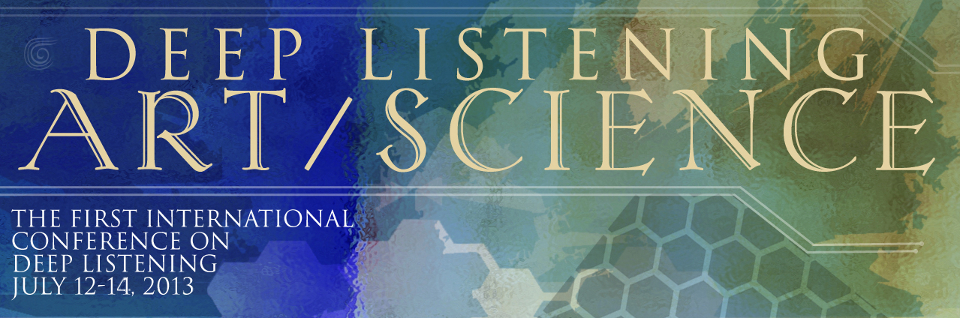
Conference flyer

Deep Listening: Art/Science 

The first International Conference on Deep Listening
July 12-13, 2013
Experimental Media and Performing Arts Center (EMPAC), Troy, NY

Organized by the Deep Listening Institute, Ltd. in conjunction with Rensselaer Polytechnic Institute

Call for Submissions

Deep Listening has been developed by Pauline Oliveros over the past 40 years as a way to enhance attention, listening and creativity for all. To this end it draws upon a wide variety of embodied practices as well as theories of cognitive science, and has been applied to a variety of fields. This includes pedagogy across all levels of education, creative arts therapy, the realization of new creative works, developing new performance paradigms across abilities and the pairing with new technologies to advance all of these fronts and more. The conference Deep Listening: Art/Science invites practitioners and scholars to consider the experience of this practice and its use in creation, communication and education. This call equally invites scientific and philosophical discussions that describe the efficacy of the approach or point towards new directions or applications of Deep Listening. We invite proposals that may include scholarly lectures, a poster presentation, experience-oriented expositions/demonstrations, or a mixture of these two.

Continue reading »

 Posted by at 5:25 pm featured Tagged with:  Comments Off on Conference – Deep Listening: Art / Science
Jan 312013
 

Lang professor Julie Napolin was recently awarded the Bruce Harkness Young Scholar Prize by the Joseph Conrad Society of America. Photo by Kasia Broussalian/The New School.

Moments of inspiration often happen to people when they least expect them: relaxing after dinner, or feverishly studying to get into grad school. As it happens, flashes of mental lightning struck novelist Joseph Conrad and newly minted Eugene Lang College The New School for Liberal Arts professor Julie Napolin, at just those moments, respectively.  And neither life was ever the same.

Continue reading »

 Posted by at 9:16 am Uncategorized Tagged with:  Comments Off on SOUNDING FOR DEPTH