Lang professor Julie Napolin was recently awarded the Bruce Harkness Young Scholar Prize by the Joseph Conrad Society of America. Photo by Kasia Broussalian/The New School.
Moments of inspiration often happen to people when they least expect them: relaxing after dinner, or feverishly studying to get into grad school. As it happens, flashes of mental lightning struck novelist Joseph Conrad and newly minted Eugene Lang College The New School for Liberal Arts professor Julie Napolin, at just those moments, respectively. And neither life was ever the same.
Making a Record (Diamond, Ruby, Sapphire, Emerald) centers around a series of four interviews the artists conducted in 2009 with gemologist and jewelry designer Karen L. Davidson, talking about the stones used to record her voice. The artists made lithic tools from the four gemstones and etched a series of unique lathe-cut dub plates of each interview. Each of the four gemstone styli were given to Karen to use as elements in four pieces she designed. These handmade pieces are composed of the stylus, crystal slices or stones in their natural states, cut gems and 22k gold. Each of the four pieces can be worn as a pendant.
Sofía Hernández Chong Cuy, Pierre Huyghe, Marina Warner and Jamieson Webster were invited by the artists to listen to the records and wear the pendants, exhibiting them for varied lengths of time. The information contained on the records was transmitted through casual conversations and occurrences that took place during their daily lives. A record of these instances has been contributed by each individual.
“In terms of speed and the breadth of material now accessible to anyone in the world, this is really revolutionary,” says audio curator Greg Budney, describing a major milestone just achieved by the Macaulay Library archive at the Cornell Lab of Ornithology. All archived analog recordings in the collection, going back to 1929, have now been digitized and can be heard at www.MacaulayLibrary.org – from Cornell University’s Tumblr
Posted by John Roach at 10:16 pmUncategorizedTagged with: newsComments Off on World’s largest natural sound archive now fully digital and fully online
“For HEARD•NY, artist Nick Cave will transform Grand Central Terminal’s Vanderbilt Hall with a herd of thirty colorful life-size horses that will peacefully “graze” and periodically break into choreographed movement accompanied by live music by two harpists. The project, which is open to the public free of charge, is presented by Creative Time and MTA Arts for Transit as part of a series of events celebrating the centennial of Grand Central.”
The 3rd Megapolis comes to New York City, April 19-21, 2013,
with its headquarters at the New School.
The MEGAPOLIS Festival examines the sonic landscape of this sprawling urban environment by showcasing artists and documentarians based in the BosWash Megapolis alongside visitors to the region, particularly focusing on the cross-pollination of knowledge championed by audio enthusiasts working in different disciplines such as music, radio, installation, and film. Performances, workshops, and presentations are scattered throughout small galleries, university halls, outdoor spaces, and sometimes living rooms within one particular mega-neighborhood. As an attendee at the MEGAPOLIS Festival you are not a member of a passive audience — you’re actively adding context to what’s coming into your ears.
A weekend-long, multi-venue event dedicated to the craft of DIY audio creation. Artists, documentarians, musicians, and fans come together to share secrets on producing and presenting challenging audio works online, on-air, and on the stage.
Check the Megapolis Festival Website In March 2013 for the lineup of artists as well as ticketing, and to check out the New School Sound presence at the festival. And click below to find out how to submit your work.
Baltimore Symphony Orchestra partners with Parsons the New School for Design
BSO Music Director Marin Alsop funds the project in honor of Tomio Taki with additional support from Parsons
Baltimore, Md. (September 13, 2012) Baltimore Symphony Orchestra (BSO) and BSO Music Director Marin Alsop are passionate about breaking down barriers that separate orchestras from their audiences. In keeping with that vision, Maestra Alsop has funded a pilot partnership with Parsons The New School for Design to create new interactions between the orchestra and its audience through a re-imagining of traditional concert dress. This semester-long collaborative studio will investigate new fashions and wearable technologies that emphasize a networked world of musicians, audiences, the music being performed and the concert hall facility.“The basic concert black worn by nearly every orchestra across the globe has been the status quo for hundreds of years,” says Maestra Alsop. “It’s time to reinvent the modern orchestra. In honor of my friend and mentor Tomio Taki, a leader in the fashion industry and Parsons board member, I’ve invited the talented students at Parsons to apply their creativity to the concert experience. These students are innovators in design and fashion and I’m excited to see their vision for the BSO for the 21st century. Concert attire is just the start. Our goal is to erase any pre-conceived notions of what a concert should look like and create an experience that is as inspiring as the music we perform.”To facilitate this vision, an interdisciplinary class of 16 Parsons students will spend the fall 2012 semester exploring the intersection of fashion design and technology, under the direction of Parsons faculty members Dr. Sabine Seymour and Scott Peterman, an alumnus of the Parsons MFA Design and Technology program. On Friday, September 14, Parsons students will travel to the BSO’s home, the Joseph Meyerhoff Symphony Hall, in Baltimore, Md. to observe the Orchestra musicians, analyze their motions and begin to visualize the music and to conceptualize fashionable attire that integrates new fabrics and wearable technologies. Parsons students will document the creative process throughout the semester.“Working with Marin is a deep honor for Parsons. Her vision and innovative spirit are unparalleled,” said Joel Towers, Executive Dean of Parsons The New School for Design.The final product will result in 5-10 prototypes of new concert attire for men and women in today’s modern orchestras. This project is the first stage in a long-term BSO-Parsons partnership that emphasizes new thinking and innovative design, from community programming to the concert hall environment, to help shape and advance an orchestra in the 21st century.
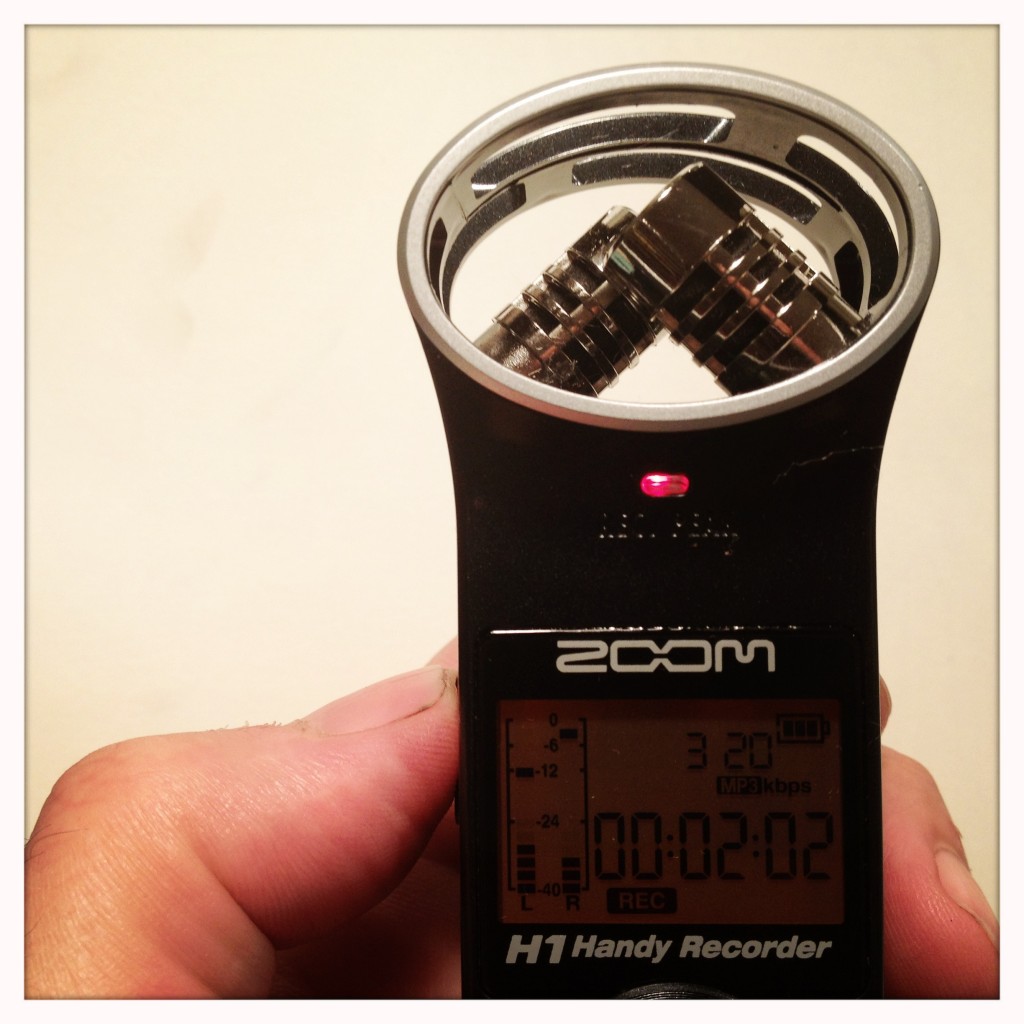
In the course Sound Matters,John Roach (faculty in the School of Design Strategies at Parsons the New School for Design) asked his students to consider the transformative act of recording and the way that it alters the reception of sound. The two projects 2pm Diaries and Reduced Listening encouraged students to be attentive not only to the varied qualities of sound, but also the way that sound can play a role in the understanding of time, and (if that doesn’t sound lofty enough) to the often unregarded aspects of daily sonic experience.
Project One – The 2PM Diaries In this project, students used handheld recorders and became generators of media. Because sound, like video is a temporal medium, students were asked to record at the same time every day (2:00 PM) and for the same duration (2 minutes). How does the act of documenting impact the perception of time? What do the recorded results represent for the recordist? For the listener? (Big thanks to Craig Dongoski whose projects inspired this project)
The act of recording, pointing a microphone at the world, can sometimes be an empowering act. It can connect you in a new way to the sounds around you. Ironically that comes through a mediating device (in this case a Zoom audio recorder), but like adjusting the lights to see something with more clarity, a recording device can sometimes snap things into focus and make you aware of sounds that you might have otherwise ignored. – from the 2PM Diaries project description
Project Two – Reduced Listening
Following up on the 2PM Diaries, students are asked to consider Michel Chion’s three modes of listening by recording short sounds in their immediate environment that could be considered in isolation as “sound objects”
“Acousmatic sound draws our attention to sound traits normally hidden from us by the simultaneous sight of the causes—hidden because this sight reinforces the perception of certain elements of the sound and obscures others. The acousmatic truly allows sound to reveal itself in all its dimensions.” – – Michel Chion
Instructions
Record 20 sounds, no longer that 10 seconds each.
Imagine someone else listening to the sound out of context.
What are sounds that generate interest when isolated from their source? Experiment, listen closely for examples inside your own home, explore the refrigerator, the cupboards, etc.
The Edits After a number of weeks of recording, students were given guidelines to create sound edits with their 2pm recordings. Each recording must use a word drawn from a class-generated pool of nouns, verbs and adjectives, as a prompt. Some limitations were: one minute in length. Use only 2PM files and reduced listening files as a source. No effects. Only edits, volume adjustments, and multitracking. One track must combine 2pm recordings with the Reduced Listening recordings.
Create one edit based on a Noun (building, sidewalk, drum, gum, television) Create one edit based on a Verb (scatter, crash, hum, drop, chase) Create one edit based on an Adjective that is not sound based (scary, repulsive, hopeless, acidic)
Empty by Sarah Marshall [:59]
Creak by Aleen Montchal [1:11]
Horn by Veine Bartos [1:03]
Archival by Gabriella D’Amato [2:11]
The Mashup
In addition to the 2PM edits, the 286 reduced listening files were played randomly through 2 instances of the Max patch Gravitas Phrase Generator
Reduction Collage [13:07]
Posted by John Roach at 9:50 pmfeaturedTagged with: projectsComments Off on Reduced Listening and the 2PM Diaries