Mar 242013
 

The Third Coast ShortDocs Challenge is back! Here’s your chance to take part in an international audio mega-project, whether you can produce radio in your sleep, or have always hungered to utter the words “Testing, 1, 2, 3. Testing” into a microphone. ShortDocs are for everyone.
The deadline for submitting your ShortDoc is April 30.

introducing all the Cooks in the Kitchen

As always, the ShortDocs Challenge comes with a set of rules inspired by a partner. For 2013 that’s the James Beard Foundation – a great organization that celebrates, nurtures, and preserves diverse culinary heritages through awards, education, and outreach.

Additionally, four Chicago-based “ShortDocs Chefs” will concoct original dishes (!) inspired by the winning ShortDocs stories. Starring: Rick Bayless (Frontera), Jason Hammel (Lula Cafe), and Iliana Regan (Elizabeth Restaurant) and one more, TBA.

More info here: http://www.thirdcoastfestival.org/competitions/shortdocs/2013


 Posted by at 10:01 am featured Tagged with:  Comments Off on Short Docs Challenge – Appetite
Mar 232013
 

The Velvet Light Trap
Call for Papers
Issue #74: On Sound (New Directions in Sound Studies)
http://www.utexas.edu/utpress/journals/papersw.html


Submission deadline: August 1, 2013

The medium of sound, long placed in a secondary position to the visual within media studies, has experienced a considerable increase in scholarly attention over the past three decades, to the point that “sound studies” is now a distinct field of scholarship. Within media studies, sound-related research today expands well beyond the film and television score or soundtrack to include a broad range of scholarship on radio and popular music. And while sound studies still tends to cohere around media studies departments, an increasing amount of sound media research is interdisciplinary in nature. A “sonic turn” is under way across the humanities and social sciences with sound studies work coming out of philosophy, sociology, anthropology, history, science and technology studies, cultural geography, American studies, art history, and cultural studies. Recent issues of differences (2011) and American Quarterly (2011) and anthologies like The Sound Studies Reader (Jonathan Sterne, 2012) are just a few examples of this expanding range of interest.

This issue of The Velvet Light Trap aims to build upon many of the new lines of inquiry that are coming out of this intersection between sound media and various other scholarly perspectives. In that spirit, we are seeking essays for an issue on the research and study of sound in and across a range of media.

Potential areas of inquiry may include, but are by no means limited to: Continue reading »

 Posted by at 3:55 pm featured Tagged with:  Comments Off on The Velvet Light Trap: On Sound – Call for Papers
Mar 232013
 

Call for submissions.
Abstract Submissions accepted now – Final Deadline August 1st (read below):
http://soundartcurating.org/call-for-submissions.html

We would like to encourage submissions, which have a practice-based approach to the analysis and discussion of the methodologies, histories, theories and interface-designs of sound art curating / sound curation. We would also like to invite submissions that take into account issues related to sound art’s audiences, reception and experiential contexts.

We solicit and encourage submissions that explore and are linked to issues related to the following areas of interest:
•Curating Interfaces for Sound + Archives
•Methodologies of Sound Art Curating
•Histories of Sound Art Curating
•Theories of Sound Art Curating
Continue reading »

 Posted by at 3:46 pm featured Tagged with:  Comments Off on Sound Art Curating – Call for Proposals
Mar 212013
 

chris-mann-ticklanguage is the mechanism whereby you understand what i’m thinking better than i do (where i is defined by those changes for which i is required).
www.theuse.info

 Posted by at 10:07 pm People Comments Off on Chris Mann
Mar 212013
 

andrea_rayAndrea Ray is a Part-Time Faculty member at Parsons in the AMT Fine Arts Department. Working at the intersection of pre-recorded and real-time experience, Ray creates environments with sculpture, light and architecture from which voices are deciphered. Audio narratives are commonly deployed to instill a sense of presence and absence investigating issues of ill-perceived relations and mis-diagnosed limitations between a subject and her environment. Recent work explores issues of subjectivity, agency and community through, for example, proposed forms of alternative living and utopian communities. Ray has taught new genres, sound installation, performance, core studio and thesis writing at Parsons. Ray’s work can be viewed and heard at www.andrearay.net.

 Posted by at 6:49 pm People Comments Off on Andrea Ray
Mar 172013
 

Reposted from wordsinspace.net, (by Shannon Mattern, NSPE, School of Media Studies)


1956

Cage’s “[Experimental] Composition,” 1956

Tonight an Australian student wrote me to ask if I happened to know anything about the courses John Cage taught at The New School in the ’50s. I’m not sure why she reached out to me in particular, but I’m glad she did. Nearly everyone at The New School knows of his storied composition course, but very few of us, it seems, know much about it. The email inquiry reminded me that our ourarchivists, led by the fabulous Wendy Scheir, had recently finished scanning all the university course catalogues since 1919 (along with university scrapbooks, the American Race Crisis Lecture Series of 1964, and the Hannah Arendt Papers). So, I skimmed through the 1956-1959 catalogues and located Cage’s “Experimental Composition” course, first offered, as far as I can tell, in the Fall of 1956. You can see the course description above.

As Jacqui Alexander writes in Pedagogies of Crossing, since the inception of its Adult Division in 1919, “The New School was envisioned as a place for new pedagogic practices [and] interdisciplinarity, and as an experiment to place education in the service of transformation… [I]ts reputation derived both from an alternative vision of education and from its outsider status — outside the Ivy League.” Over the years the university has both embraced those ideals and, at the same time, struggled to overcome the liabilities of perpetual “outsider”/”radical” status. It’s weathered periods of unrest, and, most recently, suffered some growing pains. Regardless, many of us remain proud to be affiliated with an institution that, throughout its history, has drawn “outsiders” and brave thinkers and creators like Cage, who was preceded by Martha Graham, Edwin Piscator, Aaron Copland …and the following:

Thorstein Veblen, 1919

Thorstein Veblen, 1919

Continue reading »

 Posted by at 12:08 pm featured Tagged with:  Comments Off on Cage’s “Experimental Composition” and Other New School Curricular Treasures
Mar 152013
 

HearingCall for Proposals: Due date August 31st 2013.

The medium of sound, long placed in a secondary position to the visual within media studies, has experienced a considerable increase in scholarly attention over the past three decades, to the point that “sound studies” is now a distinct field of scholarship. Within media studies, sound-related research today expands well beyond the film and television score or soundtrack to include a broad range of scholarship on radio and popular music. And while sound studies still tends to cohere around media studies departments, an increasing amount of sound media research is interdisciplinary in nature. A “sonic turn” is under way across the humanities and social sciences with sound studies work coming out of philosophy, sociology, anthropology, history, science and technology studies, cultural geography, American studies, art history, and cultural studies. Recent issues of differences (2011) and American Quarterly (2011) and anthologies like The Sound Studies Reader (Jonathan Sterne, 2012) are just a few examples of this expanding range of interest.
Read more here
 Posted by at 1:59 pm featured Tagged with:  Comments Off on On Sound (New Directions in Sound Studies)
Mar 062013
 

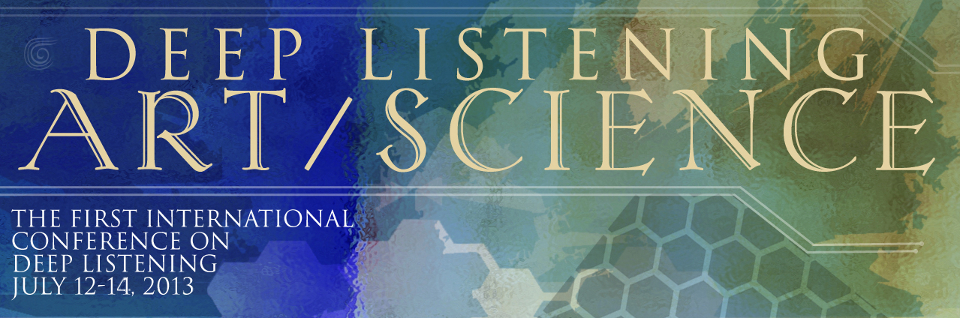
Conference flyer

Deep Listening: Art/Science 

The first International Conference on Deep Listening
July 12-13, 2013
Experimental Media and Performing Arts Center (EMPAC), Troy, NY

Organized by the Deep Listening Institute, Ltd. in conjunction with Rensselaer Polytechnic Institute

Call for Submissions

Deep Listening has been developed by Pauline Oliveros over the past 40 years as a way to enhance attention, listening and creativity for all. To this end it draws upon a wide variety of embodied practices as well as theories of cognitive science, and has been applied to a variety of fields. This includes pedagogy across all levels of education, creative arts therapy, the realization of new creative works, developing new performance paradigms across abilities and the pairing with new technologies to advance all of these fronts and more. The conference Deep Listening: Art/Science invites practitioners and scholars to consider the experience of this practice and its use in creation, communication and education. This call equally invites scientific and philosophical discussions that describe the efficacy of the approach or point towards new directions or applications of Deep Listening. We invite proposals that may include scholarly lectures, a poster presentation, experience-oriented expositions/demonstrations, or a mixture of these two.

Continue reading »

 Posted by at 5:25 pm featured Tagged with:  Comments Off on Conference – Deep Listening: Art / Science
Mar 052013
 

The Eyes of the Masters series is a special class where legendary artists share their experiences, knowledge and insights into the world of music both as an art form and as a business.


Andrew Cyrille is perhaps the preeminent free-jazz percussionist of the 1980s and ’90s. Few free-jazz drummers play with a tenth of Cyrille’s grace and authority. His energy is unflagging, his power absolute, tempered only by an ever-present sense of propriety.

Featuring:
Dorothea “Micky” Davidson – dance
Henry Grimes – bass
Adriel Williams* – violin, tap dance

*New School Jazz and Contemporary Music alumnus

See the events page for details

 Posted by at 9:46 pm featured Comments Off on Eyes of the Masters featuring Andrew Cyrille – March 15th 8pm
Mar 052013
 

The Eyes of the Masters series is a special class where legendary artists share their experiences, knowledge and insights into the world of music both as an art form and as a business.

“Mr. Taylor is his own entity: one of the most enriching and confusing boundary crossers between composition and improvisation. His art can be hard to reduce. He seems to think of his music as a kinetic act, a ritual of place and ancestry, something that lives in bodies but less so in notation and documents. And this is why his records go only so far in explaining him. His performances are the key to understanding not just his playing but also the poetry he reads in and around the music, and even his physical actions — the way he walks to and away from, and sometimes around, the piano.
But he comes from the jazz tradition. Raised in Corona, Queens, he started out as a Harlem jam-session musician in the early 1950s and talks with intense loyalty about a line of particularly New York-identified piano players: Fats Waller, Teddy Wilson, Thelonious Monk, Mary Lou Williams, Mal Waldron, John Hicks. Always there has been Ellington in his sound, driving and emphatic.”

For details See events

 Posted by at 9:41 pm featured Comments Off on March 22 – Cecil Taylor at the New School March 22nd 4-6 pm.
Mar 032013
 

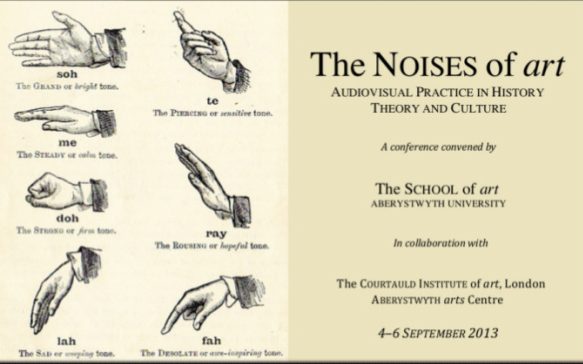
Screen Shot 2013-03-03 at 8.46.32 PM

The Noises of Art (site)
The conference addresses what is arguably the most prolific, varied, and groundbreaking period in the coming together, exchange, and mutual influence of visual art and sound-based practices (such as music and the spoken word). It aims to explore (principally) the visual artist’s engagement with sound, noise, music, and text while at the same time recognizing that there is a traffic of musicians, sound artists, and text artists moving in the opposite direction, who aspire to cultivate visual analogues for their work. Thus, the conference is situated at the intersection of several movements that are converging upon a point of visual-audio synthesis and exchange. In general, although not exclusively, the forum will provide and the opportunity to:

draw together visual artists and text-based artists who also use sound as a mode of creative production as well as musicians and sound- or noise-based artists who also use images (static or kinetic) as a mode of creative production; discuss, describe, exemplify, and present individual and collaborative practice; examine the commonalities, distinctives, and relationship of image, sound, and aural text in terms of their essence, methodologies, technologies, theories, aesthetics, historical trajectories, and modes of discourse; explore audio-visual practice from the perspective of cognitive, perceptual, and psychological studies.

We welcome abstracts for 20-minute-long papers, in all media and on any periods and regions, that deal with either case studies or broader methodological, theoretical, and historical questions, as well as proposals for improvisatory projects or presentations of 20-minute duration that can be performed at the conference. Please send either abstracts of 250–300 words or proposals of 700 words (including sample image (JPEG format) and sound or video files (mp3 or mp4 format), where appropriate) and a short biography of 100–150 words, and all inquiries to Sophie Bennett (sob@aber.ac.uk) by 30 March 2013.

For more information, please visit http://noisesofart.weebly.com

Reference / Quellennachweis:
CFP: The Noises of Art (Aberystwyth, 4-6 Sep 2013). In: H-ArtHist, Feb
28, 2013. <http://arthist.net/archive/4780>.
 Posted by at 9:02 pm featured Tagged with:  Comments Off on Conference – The Noises of Art: Audiovisual Practice in History, Theory and Culture