Apr 282013
 

braille
In this talk, Roger Whitehouse will discuss aspects of working with users to evaluate and develop design solutions. He will focus on his experience working with the senses of touch, hearing, and smell that provide information in the environment along with the visual cues  which are normally thought of as the sole vehicle of graphic design.

Wednesday May 1st.
10:30 – 11:30am
Kellen Auditorium, 66 fifth ave.

Roger Whitehouse, ARIBA, AAdipl, FSEGD
Roger Whitehouse studied architecture at the Architectural Association in London before coming to New York in 1967 to teach architecture at Columbia University. In 1975 he founded Whitehouse & Company, a multi-disciplinary design firm centered around graphic design and architectural graphics. He has been a director and vice president of the AIGA and a director and Fellow of SEGD (Society for Environmental Graphic Design). His work with vision-impaired and blind users of the Lighthouse in New York has won him many awards and international recognition in the field of Universal Design and Accessibility. His wide range of Graphic Design, Identity, Wayfinding and Industrial Design projects have included the Pratt Institute identity, and signage for Subway stations in Times Square, The HIgh Museum in Atalanta, and Lincoln Center for the Performing Arts.

 Posted by at 6:18 pm featured Tagged with:  Comments Off on Roger Whitehouse – Designing for the Senses. Wednesday May 1. 10:30am
Apr 282013
 

May 3rd  7.00 pm
66 5th Avenue, room 603
New York, NY

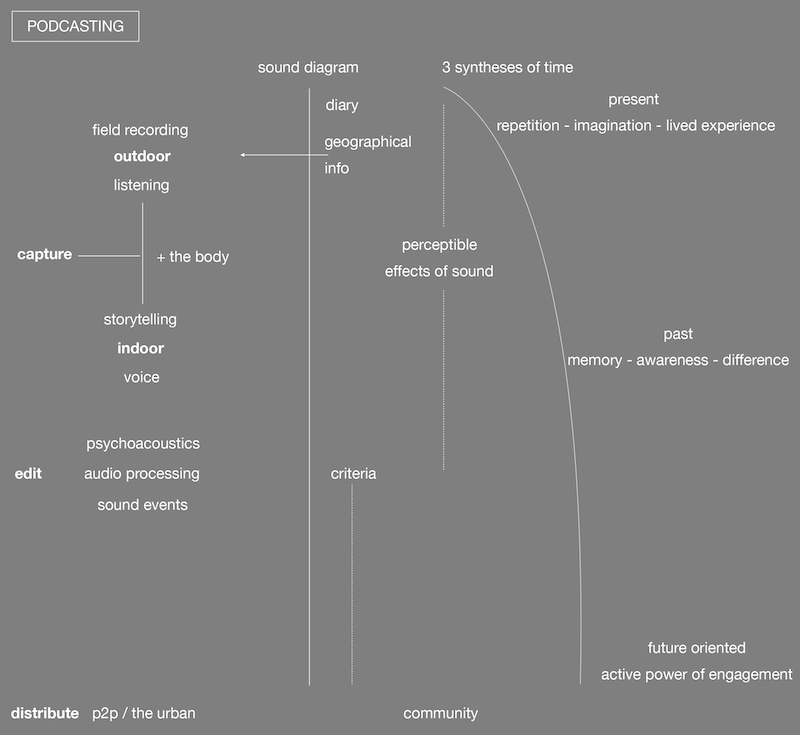
operational diagram urban podcast workshop

Podcasting The Urban event is based on a transdisciplinary workshop series on podcasting and sound design at The New School. Some of the issues that will be addressed at the event are;

How can the process of podcasting accentuate bodily awareness and feeling of presence? What connections can we draw between sense of bodily ownership, feeling of presence and dwelling patterns, through auditory experience and the making of oral histories? Concerning (modern technological audio) prosthetic devises what are the sensorial, neurophysiological, societal implications? How can podcasting be utilized as a place based associative practice?

Participants

  • Michael Premo (artist/ cultural activist, Sandy Storyline)
  • Laura Gottesdiener (journalist, Sandy Storyline)
  • Frederique de Vignemont (CNRS researcher, Institut Jean-Nicod, Paris, Visiting professor, CUNY)
  • Mary N. Taylor (urbanist & anthropologist, Parsons, Design & Urban Ecologies)
  • Molefi Mafereka Ndlovu (Centre for Civil Society, University of KwaZulu-Natal)

http://urbanismpodcasts.wordpress.com/
Workshop instructor: Themistoklis Pellas, urbanist, Parsons The New School for Design
The workshop series has been part of the courses History of World Urbanism and Spaces of Dissent/ Spaces of Control.
Faculty: Dr. Jilly Traganou, Associate Professor, School of Art and Design History and Theory
Info – Urban Podcast Workshop Series 2013:
Audio podcast generally refers to a recorded sound file made available for download through a digital broadcasting medium. Commonly, the podcasting process is approached as a mere technical matter or an information and communication technologies affordance following the co-evolution of the internet, personal computers, portable audio players and Rich Site Summary (RSS) feed. More than this though, the podcasting process crystalizes the contemporary spatio-temporal division of labor and the way the everyday realm of most urbanites is reproduced, from the scale of the body up. Understanding this tendency, the objective of the Urban Podcast Workshop Series 2013 has been to explore how podcasting can be used as a critical urban technique and tool. To achieve this, technical assistance in recording, sound engineering and broadcasting has been combined with inquiries in listening, bodily awareness, qualitative description of sound events and mapping, psychoacoustics, voice qualities, narrative modes, politics. Emphasis has been given on how the process of podcasting can amplify local-relevant urban practices, while providing a sensible understanding on the broader ecological dimensions of places.

In the workshop series podcasting has been approached as a process with three layers and addressed both as a way of knowing & through its produced output. 

  1. Audio thread
  2. Socio-spatial/acoustics framework
  3. Technical prism

AUDIO THREAD

  1. Capture – the direct collection/ production of sound facts (field recording and practitioner’s own voice recording) along with the incorporation/ correlation of secondary data (interviews, audio samples)
  2. Edit – the audio processing of the facts
  3. Distribution – the dissemination of the audio work

SOCIO-SPATIAL/ACOUSTICS FRAMEWORK
Drawing from spatial and sensory studies the framework of the workshop builds upon:

  1. Reflexivity & immersion of the practitioner in the site/ situation
    How the material self (non-discursive/ discursive) engages with the (human & non human) agents
  2. Narrative building
    The produced output as a place based storytelling & intervention into the ecology of the site/ situation

TECHNICAL PRISM
The workshop series are exploratory, while keeping a critical stance towards how technical practices are conceived & appropriated, relating more particularly to:

  1. Sensory, neurophysiological, societal implications
  2. -Political economy of hardware, software, information
 Posted by at 5:37 pm featured Tagged with:  Comments Off on Podcasting The Urban – The New School Urban Festival 2013
Apr 252013
 
Please join us for a special evening of musical and visual stimulation on Sunday, May 5 from 6:00-8:00 p.m. in the Theresa Lang Community and Student Center at Arnold Hall, 55 W 13th Street, 2nd Floor.

Interdisciplinary design teams from Parsons have partnered with musicians from Mannes to present a live showcase of interactive performances featuring avant-grade orchestral garments and motion and sound-activated technology.  This event is the culmination of a year-long collaboration with the Baltimore Symphony Orchestra to imagine the future of orchestral performance in a networked world where the audience gains access to new ways of experiencing and interacting with music – both inside and outside the concert hall.

Program:
WILLIAM BOLCOM: A Serpent’s Kiss for piano
STUART SAUNDERS SMITH:  When Music is Missing, Music Sings for percussion
LOWELL LIEBERMANN: Piano Quintet

ADMISSION: Free, advance registration required.
 Posted by at 9:52 am featured Tagged with:  Comments Off on The Future of Orchestral Garments Presented by Parsons with Mannes and The Baltimore Symphony Orchestra
Apr 242013
 

NYU’s Department of Cinema Studies presents

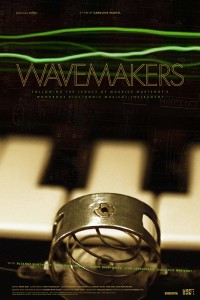
Wavemakers (2012, 96 min., dir. Caroline Martel)
A preview screening with filmmaker Caroline Martel

Following the legacy of Maurice Martenot’s wondrous electronic musical instrument.

“Amazing! A film as beautiful and tender as the instrument itself.”
– Jonny Greenwood, composer, multi-instrumentalist (Radiohead)

Wednesday, April 24, 6:15pm
NYU Tisch School of the Arts
Department of Cinema Studies
721 Broadway, 6th Floor, Michelson Theater

Screening followed by a discussion with the filmmaker.

Moderated by Dan Streible (NYU Cinema Studies).
WAVEMAKERS_poster_email

About the film:
WAVEMAKERS (2012, 96 min., dir. Caroline Martel)

After its international premiere at the Rotterdam Film Festival, and a four-week theatrical run in Montréal, Caroline Martel’s latest documentary gets a preview screening at NYU’s Department of Cinema Studies.

Wavemakers pursues the legacy of an electronic musical instrument as fragile as it is magical: the Ondes Martenot. The Martenot is indeed so sensitive, so expressive, that nearly a century after its invention, musicians, artisans and scientists are still trying to unravel its secrets. Among them are the inventor’s son, Jean-Louis Martenot, Suzanne Binet-Audet, the “Jimi Hendrix of the Martenot”, and Jonny Greenwood of Radiohead.

Integrating vérité, never-before-seen archival material and an entrancing soundtrack, this feature documentary explores the origins and workings of the Martenot, and draws us inexorably into its spell. A modern-day story set against a historical background, Wavemakers is a journey into the very heart of the mystery of music.

With Wavemakers, Caroline Martel returns with the signature approach that turned her first feature doc about telephone operators into a “non-stop visual and intellectual stimulation… an enormously creative documentary.” (Variety). She pursues her fascination with culture and technology, using her distinctive blend of humanism, lyricism and experimentation.

About the filmmaker:
Award-winning filmmaker Caroline Martel’s work has been presented to critical acclaim internationally, including at the Toronto International Film Festival and IDFA, on SRC, NHK, and SVT, at the Museum of Modern Art and the Georges Pompidou Centre, as well as at the Flaherty Seminar. Her first feature documentary, The Phantom of the Operator, showed in more than 50 venues and was reviewed as “… an enormously imaginative docu … an hour of nonstop visual and intellectual stimulation.” (Variety). Martel has been synthesizing documentary theory and practice for over a decade, with a special interest in archives, invisible histories, and audio/visual technologies and heritage. Her first gallery show, the montage installation Industry/Cinema, was presented at the Museum of the Moving Image in New York in 2012. Martel holds a BA in Communications and an MA in Media Studies, and is a research-creation PhD candidate in the joint Communications Studies program at Concordia University in Montréal. She is currently starting to develop an experimental webdoc on the prehistory of telecommunications technologies.

For additional information, please visit the film’s official website.

This event is free and open to the public.

NYU’s Department of Cinema Studies
Tisch School of the Arts
721 Broadway, 6th Floor
New York, NY 10003

 Posted by at 7:32 am featured Tagged with:  Comments Off on Wavemakers: Preview Screening with Filmmaker Caroline Martel – this Wednesday, April 24
Apr 222013
 

JBriggs_photo2

Jim Briggs has been an audio engineer and sound designer for over 15 years.  He began his professional career in music recording at Manhattan’s legendary Hit Factory Recording Studios, and has gone on to mix programs for PRI’s Selected Shorts, PBS’ American Experience, WNYC/PRX’s Here’s The Thing and numerous other series on public radio and television.  His long-running artistic partnership with VIA Dance Collaborative has been showcased on major dance stages such as the Ailey Citigroup Theater and Jacob’s Pillow.  Recently, he and choreographer Adrienne Westwood installed a multi-channel, whole-space sound design for Record at One Arm Red in Brooklyn.

As Regional Director of the 2013 Megapolis Audio Festival, Jim worked to bring innovative radio producers, sound artists and experimental musicians to The New School, including Love+Radio, Mountains, Andrea Seabrook, and The Kitchen Sisters.  Jim is a Part-Time Assistant Professor at SMS and Eugene Lang College, teaching courses in radio, sound for picture, and music technology.

 Posted by at 6:02 pm People Comments Off on Jim Briggs
Apr 222013
 

Instructor: Benjamin Tausig

CRN 1910
June 3 – June 27,
Monday-Thursday, 4:00 – 5:50
Course Description  
A Puerto Rican-born New Yorker rides his bicycle from the South Bronx over the Willis Avenue Bridge into Manhattan, a Don Omar single issuing from the boombox attached to the rear of his Schwinn. The music is amplified by his stereo system, and contorted by the Doppler effect, adjacent automobile traffic, and the flowing water of the Harlem River below.
All sound is marked by motion, but rarely more so than in a city like New York, where every block seems to represent a sonic world transplanted, where the subway is a hornet’s nest of expectations about sound and personal space, and where any sound produced will, almost by default, traverse private boundaries.
This month-long, intensive summer course meets four days a week, and examines the myriad dimensions of sound and mobility in New York, from the routes by which sonic cultures immigrate to cities to the ways that sound moves through built physical spaces, from the normative social rules of sound in spaces of transportation to broadcasting technologies that set sound in motion in new ways. We will read a rich cross-section of work including ethnographies of immigrant music, theoretical writing on sound and mobility, and practical texts on sonic field recording. In addition, students will be expected to make weekly sound recordings in the city, both on their own and in group field trips, using equipment from the New School media lab. We will explore strategies for examining and representing sound in motion in urban space. Final projects will include the option of written pieces or media presentations.
 Posted by at 10:07 am Courses Comments Off on Course Summer 2013 – Urban Soundscapes
Apr 222013
 

Jonathan Sterne

What does it mean to represent acoustic space acoustically?  What can we learn about social space by starting with sound?  This presentation uses an analysis of a specific type of artificial reverberation, called convolution, to begin the project of a differential theory of sonic space.  A convolution processor uses samples of the reverberation characteristics of a physical space and then combines those with another, “dry” recorded signal to produce the effect of the dry signal in the sampled space.  A voice or guitar can be placed in caves, tombs, halls or clothes dryers.  After providing some examples of convolution, Jonathan Sterne examines the technology as part of the aesthetic and technical histories of artificial reverberation, as a means of considering indexicality and realism in sonic representation, and as part of the informationalization of physical space-epitomized today in augmented and mixed reality applications.Jonathan Sterne teaches in the Department of Art History and Communication Studies and the History and Philosophy of Science Program at McGill University.  He is author of MP3: The Meaning of a Format (Duke 2012), The Audible Past: Cultural Origins of Sound Reproduction (Duke, 2003); and numerous articles on media, technologies and the politics of culture.  He is also editor of The Sound Studies Reader (Routledge, 2012).  Visit his website at http://sterneworks.org .This event is open to Media Studies and Parsons students and faculty ONLY.
Location:
Hirshon Dining Suite / 55 West 13th Street, rm 205Admission:
Free; no tickets or reservations required; seating is first-come first-served
 Posted by at 9:54 am featured Comments Off on [SMS Speaker Series] Jonathan Sterne – Sampling Space: Convolution, Echo and Culture – April 30 4-6pm
Apr 212013
 

Instructor: Sarah Montague and James Briggs
Fall 2013 Undergraduate Studio
Eugene Lang College
CRN 3873
Fridays 12:10 – 2:50
Limit to 14 Students

This course is devoted to the continued development and programming of the online radio station WNSR (newschoolradio.org).  The goal of each class will be to provide students with the tools to create vibrant content and a practical management base for the station as a continuing University-wide enterprise.  Students will learn both basic production techniques and concepts related to the creation of culture and news programming for the station, which operates on the public radio model linking imaginative sound with social awareness.

 Posted by at 4:58 pm Courses Comments Off on Course Fall 2013 – ON AIR
Apr 212013
 

Instructor: Sarah Montague
Fall 2013 Undergraduate Seminar
Eugene Lang College
CRN 7410
Monday and Wednesdays 3:50 – 5:30
Limit to 18 Students

This course will present the theory, aesthetics, and practical applications of radio and audio production.  It will cover the development of recorded sound, early acoustic works and sound art, radio production in the context of the radio broadcast industry and radio/audio production today in various contexts such as commercial and public radio, audio books, and webcasting.  While not an engineering course, students will also learn practical skills related to production concepts and design, and the various formats in which productions are realized: news and cultural features, documentaries, docu-dramas, audio books, and drama.  We will also touch on related fields such as film and theatre sound, and sound art.

 Posted by at 4:53 pm Courses Comments Off on Fall Course 2013 – Audio Culture 2: Indeterminances–Radio & Audio Aesthetics
Apr 212013
 

Instructor: Sarah Montague
Fall 2013 Undergraduate Studio
Eugene Lang College
CRN 7802
Wednesdays 12:10 – 2:50
Limit to 18 Students

Course Description:
The Skybridge Art & Sound Space, which bridges the 11th- and 12th-street college buildings on the third floor, is a vibrant and exciting laboratory for aural concepts and critical thinking. Students will learn the history and practice of audio art—including discussions of works by innovators such as Walter Ruttman; John Cage; Pauline Oliveros—in the context of exhibition conceptualization, the gallery arts, and installation practice.  Students will work towards the creation of at least one, and possibly two, installations in the Space.

 Posted by at 4:47 pm Courses Comments Off on Course Fall 2013 – Skybridge Sound
Apr 212013
 

Sarah Montague, an adjunct faculty member of Eugene Lang College since 2002, has been an independent radio/audio producer for over twenty-five years. At the New School, she teaches courses in radio and audio aesthetics, radio documentary, radio drama, and sound design, and helped found the New School’s online radio station, newschoolradio.org (WNSR), for which she is one of two faculty advisors.

She is the producer of the National Public Radio-distributed spoken word/drama programs Jazzplay and The Radio Stage, and Public Radio International’s popular short story series Selected Shorts (which she has produced since 1996).  She is the creator of documentary specials on the cultural history of The Titanic, Adrienne Rich, Virginia Woolf, and Sir Tom Stoppard among others.  Her production of Archibald Macleish’s The Fall of the City, and an accompanying documentary, The Fall of the City: Prophetic Classic, won awards from The New York Festivals and The Alliance of Women in Media.   She is also a cultural feature producer, and her work has been heard on Morning Edition, Studio 360, and On the Media.   She has also worked in audio publishing as an adaptor and director/producer.  She is a former board and faculty member of the National Audio Theatre Festivals, and a published critic and essayist.

 Posted by at 4:38 pm People Comments Off on Sarah Montague
Apr 042013
 

LDavis_vLeigh Davis is an artist and educator.  Her work investigates the relationships between people and the physical spaces in which they live, work, and perform.  Leigh’s subjects span a broad range—from the men of a dying religious order, to women living in a YWCA residence hall, to a variety of performers (tap dancer, Michael Jackson impersonator, a cappella choir, conductor) —and the projects she creates derive from the relationships she develops with those subjects over time.  Gathering visual and aural material around a person or place is how her projects usually begin, but the final products are site-specific installations or situations created from a variety of media, and are deeply informed by their subject matter and the sites in which they are presented.  Davis teaches at Parsons within the School of Design Studies, and the International Center of Photography.  She also teaches high school students in collaboration with The Center for Urban Pedagogy.

You can see some of her work at: http://leighdavisprojects.com/site/

 Posted by at 10:07 am People Comments Off on Leigh Davis
Apr 042013
 

Instructor: Shannon Mattern
Fall 2013 Graduate Seminar (advanced undergrads welcome)
CRN 6731
Tuesdays 4 – 5:50pm
2012 Course Website

*While this course is not explicitly about sound, students can tailor their projects to focus on audio archives, music libraries, or other sound-related topics.

“There has been more information produced in the last 30 years than during the previous 5000.” We have all heard some variation on this maxim. As U.S. publishers add 250,000 printed books and close to 300,000 print-on-demand books to our libraries each year; as we find ourselves wading through over 200 million websites; as we continue to add new media – from Tweets to Apps to geo-tagged maps – to our everyday media repertoires, we continually search for new ways to navigate this ever more treacherous sea of information. Throughout human history we have relied on various institutions and politico-intellectual architectures to organize, index, preserve, make sense of, and facilitate or control access to our stores of knowledge, our assemblages of media, our collections of information. This seminar looks at the past, present, and future of the library, the archive, and the database, and considers what logics, priorities, politics, audiences, contents, aesthetics, physical forms, etc., ally and differentiate these forms of data storage and filtering. We will examine what roles the library, archive, and the database play in democracy, in education, in everyday life, and in art. **This class is the first in a two-part series; in Spring 2014, we’ll be consulting with archivists, librarians, and designers to develop a  digital archive for The New School. Students are strongly encourage to enroll in both the Fall and Spring courses.

ArchivesLibrariesImage
Image via — Wikimedia Commons

 Posted by at 9:27 am Courses Comments Off on Course Fall 2013 – Archives Libraries and Databases
Apr 042013
 

Instructor: Shannon Mattern
Fall 2013 Graduate Studio (advanced undergrads welcome)
CRN 4168
Wednesdays 7 – 9:45pm
2012 Course Website

*While this course is not explicitly about sound, students can tailor their projects to focus on sonic media in urban environments — radio, loudspeakers, musical performance, etc.

Today’s city is layered with screens of all shapes and sizes and stitched together with a web of wireless networks, but woven into these modern media spaces are other, older urban media networks and infrastructures – many of which have laid the foundation for our newer media. This project-based course is dedicated to excavating and mapping – both theoretically and practically – the layers of mediation that have shaped urban forms and informed urban experiences through several key epochs in communication history, from the oral culture of ancient Athens to the television age. Each student, alone or in pairs, will conduct an urban media excavation – exploring, for example, how pneumatic tubes facilitated the delivery of mail in late-19th century New York, how the rise of the film industry shaped early 20th-century Los Angeles, or how television cables served as the nervous system of new mid-20th-century suburbs. Rather than presenting this work as atomized individual projects, however, everyone will plot their sites and networks, and post relevant archival media, to a collaboratively designed interactive media map. Part of the class will be devoted to designing the platform by analyzing which presentation format is best suited for effectively displaying these layers of urban mediation and exploring the synergies between individual students’ projects. The class will lay historical and theoretical groundwork for examining media and the urban environment, and also introduce students to the fields of media archaeology and the digital humanities.  While students will participate in the creation of interactive media maps, this hybrid course will have a strong theory component.

Image via — Creative Commons license
UrbanMediaArchaeologyImage

 Posted by at 7:52 am Courses Comments Off on Course Fall 2013 – Urban Media Archeology
Apr 032013
 

Eisler Blog

The Austrian Cultural Forum is pleased to present this interdisciplinary evening which will focus on the Nazi propaganda machine and some of its outspoken adversaries.
Event Details here

Shortly after Hitler became German chancellor in January 1933, the Austrian writer Karl Kraus began his work on a documentary essay about the Nazi regime: Third Walpurgis Night. Simon Ganahl, an Erwin Schrödinger Fellow of the Austrian Science Fund, analyzed the media references of Kraus’ text, and discovered insights that in fact anticipate Marshall McLuhan’s famous postulate, “the medium is the message.”

The multimedia lecture will be framed by a live performance of songs by the Austrian composer Hanns Eisler, featuring the singer Theo Bleckmann. New School scholar and composer Barry Salmon has arranged the music for string quartet, which will be performed by:

Joyce Hammann, violin
Mark Feldman, violin
Lois Martin, viola
Jody Redhage, cello

Finally, a discussion on political propaganda, moderated by NYU professor Mark Crispin Miller, will conclude the evening’s program.
Theo Bleckmann sings Hanns Eisler’s “An den kleinen Radioapparat”:

Continue reading »

 Posted by at 11:31 pm featured Comments Off on MULTIMEDIA LECTURE & CONCERT – THE POLITICS OF UNENLIGHTENMENT – WEDNESDAY APR 10, 06:30 PM
Apr 032013
 

big ears cropInstructor: John Roach
Wednesdays 3:50 – 6:30
CRN: 6136    PSDS 3703
Open to all Undergraduate students at the New School
sndmatters.tumblr.com/course

This course is all about your ears. Starting with a focused attention to the sounds of the city, you will launch into projects that interact with, interrupt, or unmask the sonic world around us.  Sound Matters is an explicitly interdisciplinary studio and offers the opportunity to create projects that might include field recording, sound collage, sound installation, audio intervention, performance, sound sculpture, drawing, or written explorations.  The ultimate goal is to become a careful listener and to enter into a deliberate engagement with sound in your work.
The ear is a powerful and underutilized tool and working with sound can offer another path toward becoming a perceptually sensitive artist, designer, or creative thinker. Points of reference for this course are drawn from fields as diverse as science, experimental music, performance art, and urban planning.
No prior experience working with sound is required, but students will have an opportunity to build their existing experience into their projects.

 Posted by at 10:33 pm Courses Comments Off on Course Fall 2013 – Sound Matters
Apr 022013
 

Instructor: Joan Schuman
ONLINE COURSE CRN: 3720.
Limited to 15 students.

Course Description:
While sounds have been explored by both listeners and au(di)teurs for millennia, it is only within the last 130 years that mediated technologies—the phone, the phonograph, popular radio broadcasting—have permitted artists to produce work that leaves an archival, sonic trace. In this course, students gain a foundation of how sound has entered the mediated and artistic landscape by exploring contemporary artists who “ensound” (as one “envisions”) media for presenting audio- based creative work across numerous genres. These include: gallery and site-specific installations; radio artistry via terrestrial and online broadcasting; Web-based performances; international sound-art festivals; darkened cinematic airings; LP/CD anthologizing; and sound walks via new technologies (cell phones, WiFi networks, GPS tracking).

Understanding the historical-contemporary contexts of “sounded” production (Dadaist experimenters; Cagean silence practitioners; Burroughs cut-up artists; tape-art mailers; radio pirates; podcasters; mobile phone artists) allows students to question their relationship to sound as a mode of communication in either creative productions or research-based work.

This is an academic seminar that critically explores both the historical and contemporary sound and media art geographies. Students are also invited to hone rudimentary skills in approaching sonic artistry as practitioners. All students conduct sound walks; deep listening exercises; sound scavenging forays; and numerous eavesdropping expeditions in experiential relationship with their academic research. The class culminates in contributions to sound culture discourse via a curating project.

 Posted by at 10:45 pm Courses Comments Off on Course Fall 2013 – Sound Culture
Apr 022013
 

JSPhoto1

Joan Schuman is Part-Time Assistant Professor since 2004 teaching sound studies courses in the MA Media Studies program (Radio Narratives, Sound Culture, Audio Experiments) and courses in creative radio, culture of podcasting, history of listening and the newly minted Media, Nature & Apocalypse in the BA program, New School for Public Engagement. Her radiophonic practice began in the mid-’80s via public radio documentaries and evolved into artistic radio explorations in the early-’90s. Now she swaps forms at whim, encouraging her radio works to be artful and her artistry to tell stories. She is also a curator of radio and sound art via various broadcast and online projects, which can be explored at HyperAcousia.

 Posted by at 5:57 pm People Comments Off on Joan Schuman
Apr 022013
 

radio

Instructor: Joan Schuman
ONLINE COURSE
CRN: 1287
June 3-August 2
Limited to 15 students

Course Description:
Summer offers a rich tapestry of sound as we fling open the windows (in most geographies) and eliminate the barriers between indoors and the cacophonous soundscape outside. Whether students are located in the traffic-laden city or the bird-twittering country, theres a range of stories to be consumed, collected and shared. We’ll step out into those summer sounds to produce hot and humid, foggy and chilly or searing stories under the punishing sun. This course offers a space to workshop a fully produced narrative work suitable for radio broadcast. Several short productions invite students to collect stories on outdoor sound walks, explore seasonally specific characters, and experiment with form and narrative subjects before tackling their semester- long projects. Class critiques will enable students to carefully polish their individual productions. We’ll listen to a range of narrative styles in order to understand production possibilities–from singular voices to complex layers of sound that create an impressionistic autobiography; to stylistic innovations in documenting cultural and political issues; to hybrids of interviews immersed in poetic aurality. We’ll consider work broadcast in many outlets, including public radios familiar “This American Life,” radio programs in Australia, Europe and Canada, and community and podcast radio that take risks to air less- conventionally constructed stories. The class is designed for students with basic audio production skills and access to tools (on-site at New School labs or via their own computer/audio set-up).
* Recommended: Digital editing experience or audio/radio production classes
* Required: Access to recording and editing/mixing tool


More information:
This summer marks a dozen iterations of the online course, Radio Narratives, taught by Joan Schuman. and, since its launch, we’ve witnessed seemingly dramatic changes in radio itself (popularity of podcasting and online radio streaming, but also a re-birth of lo-fi narrowcasting, transmission arts and other evolving radio-esque landscapes). The core of the course is focused on telling stories in sound. Radio structures may have changed, but narrative design is gloriously stalwart:

” … this happened, then this happened, then this is how she felt when this happened…”

How we mold voices, sounds, impressions and feelings to tell such stories is where the ears stay tuned. Radio Narratives gathers a range of student participation, skills and focus—from musicians to documentary filmmakers to oral historians to visual storytellers—each a new radio-maker. And summer offers a rich tapestry of sound to capture as we fling open the windows (in most geographies) and eliminate the barriers between indoors and the cacophonous soundscape outside. As such, this online summer course explores a gamut of radio styles, from a single, intimate whisper of a voice to layers of sounds that create an audibly vibrant “cinema for the ear.” Students workshop numerous styles on their way towards a culminating project via real-world radio competitions and programming submissions that hone production and narrative development skills.

Amazing work has come out of this course over the years. Listen to samples below and if you have questions about the course or online classes and navigation, I am available to have a conversation from my home office in Northern California where I’ve been teaching Radio Narratives (and several other sound studies online graduate and undergraduate courses for nearly a decade at The New School. Feel free to e-mail me at <schumanj@newschool.edu>.

Listen to samples from former students:

Kevin Allen
Marie’s Crisis (9:41)
Daddy’s Gone (2 minutes)

Tom Tenney 
Reunion (5:02)
We Are All Underground (4:45)
[scroll down to sound samples/right side]

Cambra Moniz-Edwards
Pills (3:01)
[submission for Third Coast Festival’s short doc challenge, 2008]

Jesse Ricke
I Didn’t Know That (3:00)
[submission for Third Coast Festival’s short doc challenge, 2010]

 Posted by at 5:37 pm Courses Tagged with:  Comments Off on Course Summer 2013 – Radio Narratives: Summertime Sounds